


Winter Grazing Strategies for Healthy and Happy Horses

During winter horse and pony owners may face challenges in managing their animals' grazing habits and grass intake. The availability and quality of pasture can drastically change during the colder months, impacting the health and well-being of horses in different ways. Understanding the dynamics of winter grass and the various grazing options is crucial for maintaining optimal nutrition and preventing health and welfare issues such as laminitis, ulcers, colic, behavioural changes due to low fibre intake and boredom. This guide aims to provide some insights into winter grazing management, including the characteristics of winter grass and practical strategies for managing a pony's diet during this season in NZ. By equipping ourselves with this sort of knowledge, we can ensure that our horses and ponies remain healthy, happy, warm and properly nourished throughout the winter months.
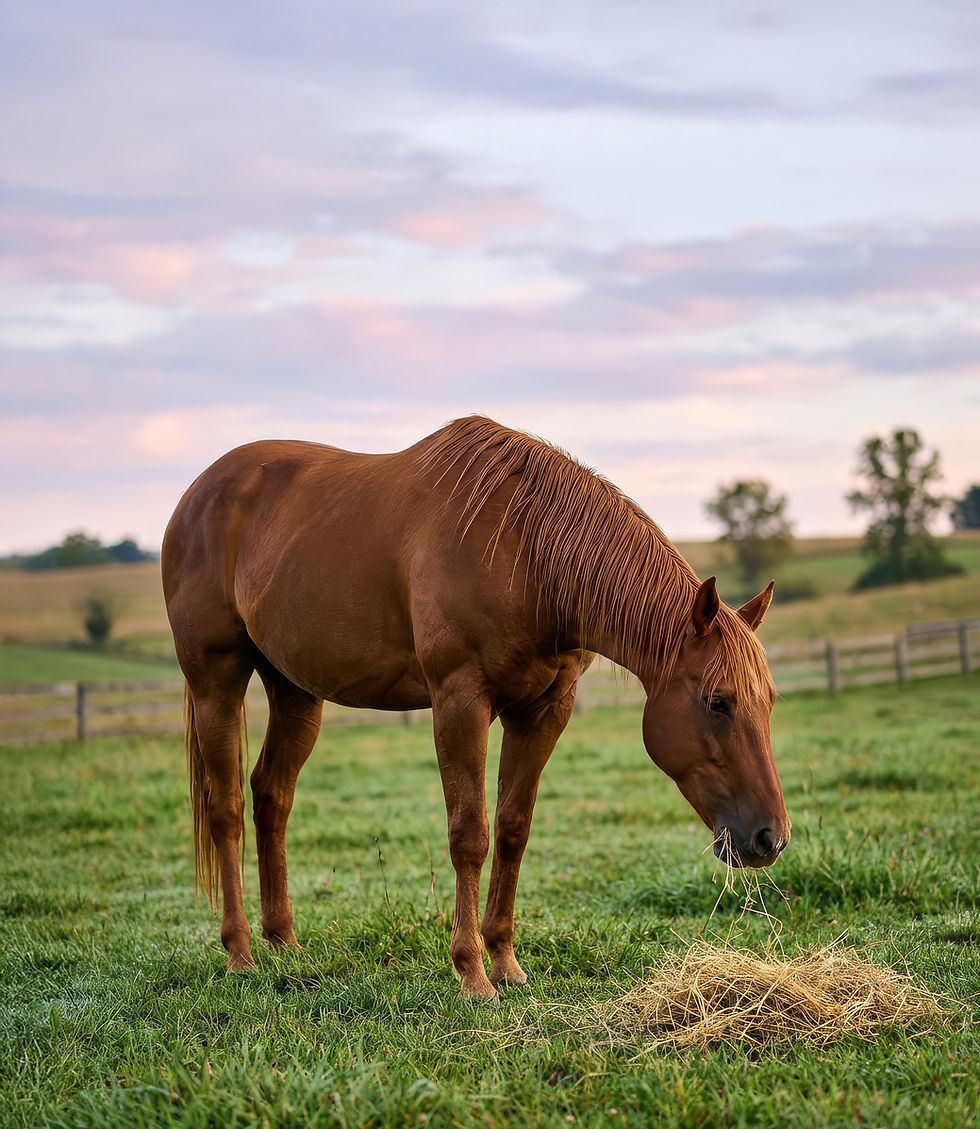
Ponies evolved on sparse upland grazing and are highly efficient at extracting energy from grass. In New Zealand paddocks, this is always a significant management challenge. In particular, Hawke's Bay where GlenOlive Equitation in situated, has warm, fertile soils that can produce rich, rapidly growing pasture even in autumn.
1. How Much Can a Pony Eat in a Day?
Ponies eat a fibre diet and can graze for around 16 hours a day if they need to, where food is limited. Where adequate food is available they will naturally consume between 2% and 2.5% of their bodyweight in dry matter per day. Dry matter (DM) in horse feed is the portion of the feed that remains after all the water (moisture) has been removed. It represents the actual, concentrated nutrients. When feeding horses its worth remembering that:
Grains might be 90% dry matter (10% water).
Hay is typically 85–90% dry matter (10–15% water).
Fresh pasture/grass can be up to 80–85% water, meaning it is only 15–20% dry matter.
Daily Intake Estimates by Bodyweight | |
200 kg pony | 4.0 to 5.0 kg dry matter per day (which equates to roughly 15 to 20 kg fresh grass) |
300 kg pony | 6.0 to 7.5 kg dry matter per day (roughly 22 to 30 kg fresh grass) |
400 kg pony | 8.0 to 10.0 kg dry matter per day (roughly 30 to 40 kg fresh grass) |
2. Grass Types and Seasonal Risk in Hawke's Bay
Common Pasture Grasses
Although there may be paddocks with grass varieties designed for feeding diary cows or fattening bulls, most of Hawke's Bay paddocks contain a mixture of ryegrass, cocksfoot, browntop, various clovers and weeds. Each of these has different nutritional profiles and risk levels when it comes to feeding horses and ponies:
Hawke's Bay Pasture Types and Pony Risk | |
Perennial ryegrass | Very high sugar content, especially in spring and after rain following drought. The highest-risk grass for ponies. Widely sown across Hawke's Bay’s farmland especially where livestock are being fattened. |
Endophyte ryegrass | Contains fungal endophytes that can cause ryegrass staggers in late summer and autumn. Symptoms include trembling, stumbling and excitability. Often seen in cattle and sheep. |
Cocksfoot | Lower sugar than ryegrass; generally safer but still rich in lush conditions. |
Browntop / bent | Lower energy; useful as a component in a mixed sward for ponies. |
White clover | Very high in protein and sugars; should be grazed only in small amounts. |
Kikuyu | Common in warmer Hawke's Bay areas (not at GlenOlive); very high in oxalates if dominant, which can interfere with calcium absorption. |
Seasonal Risk Patterns
Hawke's Bay has a warm, semi-arid climate usually with dry summers and wetter winters. Autumn can be a high-risk period for grass related issues because:
• Autumn grass flushes occur as temperatures drop and autumn rain arrives after summer dry spells. Non-structural sugars (NSC) accumulate in the plant as growth slows.
• Frosts concentrate sugars further in leaf tips.
• Grass can look short and brown on top but still be nutritionally very rich at the base.
• Endophyte toxicity peaks in late summer and early autumn, increasing ryegrass staggers risk.
Winter brings slower grass growth and lower overall sugar content, which reduces some risks.
3. What Causes Grass-Affected Behaviour?
This is a well-recognised phenomenon in parts of New Zealand though not fully understood in scientific literature. The main culprits are:
Causes of Grass-Affected Behaviour | |
High NSC (sugars and starch) | Lush grass is high in non-structural carbohydrates. A rapid rise in blood glucose, followed by an insulin spike, can affect mood and energy levels. This is the most common driver of behavioural changes. |
Fructans | A form of sugar stored in grass stems, particularly in ryegrass. Fructans are fermented in the hindgut and can cause digestive upset, including laminitis (founder), and may contribute to excitability. |
Magnesium deficiency | High potassium in lush grass interferes with magnesium absorption. Low magnesium causes nervousness, spookiness, muscle tension and poor tolerance of handling. This is very common in NZ ponies on autumn pasture. |
Endophyte toxins | Produce the "ryegrass staggers" syndrome; incoordination, trembling, falling. Worse in dry or stressed pasture conditions. Remove affected animals from pasture immediately. |
Selenium imbalance | NZ soils are often selenium-deficient, contributing to muscle weakness and poor coat condition. Seek veterinary advice before supplementing, as selenium toxicity is also dangerous. |
What This Looks Like
Typical signs of a grass-affected pony include:
• Sudden spookiness, bolting or bucking that is out of character
• Hypersensitivity to touch, particularly around the back and loins
• Reluctance to be caught or handled
• Tight, uncomfortable movement or apparent muscle soreness
• Hoof sensitivity, warmth in the hooves, or reluctance to move forward (early laminitis)
• Incoordination or trembling (ryegrass staggers)
The primary solution is to reduce grass intake, ensure alternative fibre availability in the diet and use a toxin-binder.
4. Managing Grass Intake: Practical Strategies
Strip Grazing
Strip grazing divides the paddock into small sections using temporary electric tape, allowing access to only a narrow strip at a time. It is the most effective way to control intake and rest the remainder of the pasture.
• Move the strip forward daily or every two days depending on grass availability.
• Rest strips allow grass to recover without being overgrazed to a dangerous short-sward state.
• Aim for grass height of 8 to 15 cm in the strip being offered - not shorter.
• If you can, use a back fence to allow previously grazed areas to start to recover.
Grazing Muzzles
Slowing intake whilst keeping the horse busy with foraging is a common strategy used to manage overweight or at risk ponies
A grazing muzzle restricts the bite size and slows intake by approximately 75 to 85%. They are highly effective for ponies in good or overweight condition on lush grass:
• Introduce the muzzle gradually to allow the pony to adapt.
• Check fit daily - it must allow drinking but not permit full-bite grazing.
• Remove for at least 2 hours per day to allow normal eating and socialisation.
• Do not use in very hot weather.
• Inspect the muzzle and the pony's face daily for rubs or sores.
Slow release Hayfeeders
There are various slow feeding devices on the market, hay balls, slow hay release nets and others - and these can help provide the food needed but extend the time taken, as well as to mimic a more natural 'foraging' activity which can be more stimulating for the horse.

Rotational Grazing
Dividing the paddock into two or more sections and rotating the pony between them allows each section to rest and recover, and prevents the boom or bust situation that can be caused by over grazing. Unlike strip grazing, the pony has access to an entire section at a time.
• Suitable where available land area is sufficient and pony condition is moderate rather than very high risk.
• Rest periods of 3 to 6 weeks (depending on pasture type, space and how grazed it is) for pasture recovery.
‘Sacrifice’ Paddock or Yard Rest
In high-risk periods, especially at the peak of autumn flush or if a pony is showing signs of laminitis, removing all grass access is the safest option. A sacrifice paddock (bare earth or very sparse grass – such as the paddock next to the donkeys) or a yard with hay and water allows full control over intake.
• Provide good quality low-sugar hay or a mature meadow hay rather than ryegrass hay.
• Soak hay for 30 to 60 minutes in cold water before feeding to reduce water-soluble sugar content.
• Ensure constant access to fresh water.
• Even in a yard, light exercise or hand-walking is beneficial for gut motility and hoof health.
Fibre, Fibre, Fibre ....
Providing access to fibre ( grass, hay, even good quality straw) is essential for meeting both nutritional AND behavioural needs.
Short Grass vs Long Grass
This is a frequently misunderstood issue. People think that over grazing a paddock will help the at arisk pony or horse. However, shorter grass is not necessarily safer for equids - this depends on the season, the grass type and the weather too. Long stalky 'old' grass has lots of fibre which is important for digestion and may be safer for the at risk horse, if the amount is managed. The key points are that:
• Short, actively growing grass (3 to 6 cm) is often highest in NSC because the plant is directing all its energy into leaf production.
• Overgrazed paddocks with short, stressed grass can still cause laminitis.
• Anything that stresses a plant will raise the sugar levels eg: drought or frost or overgrazing
• Longer, mature grass (over 20 cm) has more fibre and a lower proportion of NSC to total volume.
• The most dangerous pasture for overwright or at risk ponies or horses is short, lush, fast-growing ryegrass after rain or during an autumn flush.
6. Supplementation and Forage
All horses need adequate amounts of fibre in their diet.
Horses are both hind-gut fermenters and trickle feeders, and they require appropriate quantities of fibre for both their physical and mental wellbeing. Horses on low fibre diets (often the case where grazing has been extremely restricted or where intake is being restricted as part of their fitness/performance management such as in racehorses) are at risk of developing health problems such as ulcers and may experience gut discomfort and even colic. Oral stereotypies and behavioural problems may also develop as the horse attempts to cope with the situation. For many of Hawke's Bay ponies on restricted grazing, targeted supplementation addresses specific nutritional gaps, but ensuring good fibre intake (low feed quality hay, strip grazing, long stemmed chaff or good quality straw) is essential:
• Add Magnesium daily to feed. This is the single most commonly beneficial supplement for grass-affected ponies in NZ and is inexpensive. Magnesium oxide (MgO):
• NZ soils are often deficient in selenium. Always test before supplementing. Selenium/vitamin E:
• Do not add grain, molasses, or sweet feeds. Use a low-NSC balancer pellet if extra nutrition is needed. Avoid high-sugar feeds:
For a pony in light work and maintaining good condition on restricted pasture alone, additional hard feeding (other than for mineral etc supplementation) is often unnecessary.
7. Seasonal Guide
Season | Main Risk | Priority Action |
Autumn (Mar-May) | Autumn grass flush; high NSC; endophyte risk; ryegrass staggers | Strip graze or muzzle; avoid frosted grass; watch for staggers; consider magnesium supplement |
Early winter (Jun-Jul) | Depending on weather - slower growth but flush possible after rain | Sacrifice paddock in wet spells; check hooves daily; provide hay; limit access after rain |
Mid-winter (Jul-Aug) | Low-quality pasture; possible selenium deficiency | Provide good hay; light exercise; test selenium levels with vet |
Spring (Sept-Nov) | Highest laminitis risk; very rapid grass flush; high fructan content | Maximum grazing restriction; muzzle; yard as needed; early morning grazing only |
Further Reading:


Comments